
We keep hearing the same grim headlines. Society is getting sicker. The numbers don’t lie: nearly two-thirds of American adults are overweight, and more than 30 percent are obese, according to the U.S. Department of Health and Human Services. These figures are climbing. The Journal of the American Medical Association confirms the trend. It’s not just the U.S., either. As cultures worldwide adopt Western habits—fast food, massive portions, sedentary lives—the threat is global.
Being underweight carries its own dangers, sure. But the CDC reports that less than 2 percent of the population falls into that category, and that number is shrinking. So, where does that leave you?
If you’re searching for your healthy body weight, you need a clear definition of what that actually means. It’s not just a number on a scale. It’s the weight at which you can lead a vigorous, well-balanced life now and for the long haul. Popular culture complicates this search. You’re bombarded with images of waif-like models and airbrushed movie stars. Then there are the gargantuan hulks of the fitness industry. Both extremes distort reality. You are a unique creature with physical characteristics that are yours alone.
Most formulas used to find this weight are inaccurate. They ignore the nuance of your body. Let’s look at the most popular indicator: the BMI.
Is Body Mass Index Actually Reliable?
You’ve likely seen the charts. They list ideal weight ranges based on height. This is the Body Mass Index. Unlike a standard bathroom scale, which only tells you total mass, the BMI attempts to estimate fat content. The formula is simple: multiply weight by 700, divide by height in inches squared. The result lands you in a range: underweight, healthy, overweight, or obese. The World Health Organization considers a BMI between 18.5 and 24.9 to be healthy.
Doctors often use this as a starting point. It’s easy to assume the BMI is the gold standard. It isn’t.
The formula was created in the mid-1800s by Adolphe Quetelet, a Belgian statistician. He wanted to define the “average man.” While groundbreaking for its time, the Quetelet Index has massive limitations for the individual. It doesn’t differentiate between lean mass and fat. That’s a critical flaw. Muscle weighs more than fat. A stocky athlete might be categorized as overweight or obese by the BMI, even if they are quite lean.
The index also ignores race, sex, and age. Women naturally need more body fat. Lean muscle mass declines as we age. Then there’s where you carry the weight. The Mayo Clinic stresses that an apple-shaped body (excess weight in the abdomen) poses a greater disease risk than a pear-shaped body (excess weight in the hips). The BMI doesn’t see that difference.
Don’t confuse your BMI reading with your body fat percentage. The BMI is a formula, not a percentage, and it broadly defines your physical makeup.
The BMI can start the search for your ideal weight. But it has serious flaws. A deeper, more complex search is necessary to determine a healthy body weight with accuracy.
The Extreme Case
Consider Jay Cutler, the bodybuilder (not the NFL player). He stands 5 feet 9 inches. He weighs 270 pounds. If you plug those numbers into a BMI calculator, the result is roughly 40. The chart labels him dangerously obese.
But Cutler is remarkably lean. He eats about 6,500 calories a day. He won the Mr. Olympia title in 2010. Like other pro bodybuilders, he enters competition with low single-digit fat levels. Cutler is an extreme example. He proves the limitations of the body mass index. It fails to account for the density of muscle tissue.
We need to look at other tools. The BMI is just a gauge, not the final verdict.
Stop Trusting the Scale Alone
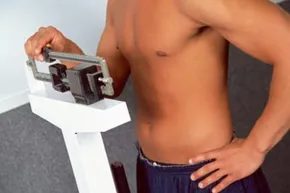
Here is the uncomfortable truth: the number on the bathroom scale is largely a lie. Medical experts have known this for years. Weight alone tells you almost nothing about your actual health. It is what that weight is made of that determines your risk for disease, your energy levels, and your longevity.
The Body Mass Index (BMI) is the standard metric we are all forced to use, but it is deeply flawed. It relies on just two variables—height and weight—to categorize your entire health profile. That is it. It ignores muscle mass, bone density, and where your fat is actually stored. A fit athlete and a sedentary person with the same height and weight will have vastly different health risks, yet BMI treats them identically.
Why Waist-to-Height Ratio Matters More
If you want a more accurate picture of your health without booking a pricey medical scan, start with the waist-to-height ratio. Recent research from experts in the U.S., Germany, and Austria confirms this metric is a far better predictor of heart disease risk than BMI. It accounts for the distribution of fat, which is critical because visceral fat (the kind around your organs) is metabolically dangerous.
How do you calculate it? It is simple.
For women: Multiply your height in inches by 0.53.
For men: Multiply your height in inches by 0.55.
Your waistline should be equal to or less than that resulting number. If your waist is larger than half your height, you are carrying excess abdominal fat. This is a red flag for cardiovascular issues, independent of your total body weight.
The Simple Tape Measure Test
Not interested in doing math? You don’t have to. A simple tape measure around your waist is often enough. The American Heart Association and the National Heart, Lung and Blood Institute have clear benchmarks.
For women, a waist circumference greater than 35 inches (88 cm) indicates abdominal obesity.
For men, the threshold is 40 inches (102 cm).
Abdominal obesity is not just about fitting into jeans. It is a clinical indicator of metabolic syndrome. It raises your risk for type 2 diabetes, heart disease, and high blood pressure. You can be “skinny” by scale standards and still be at high risk if your fat is concentrated in your midsection.
The Skinny-Fat Paradox
This brings us to the “skinny-fat” phenotype. You look thin. Your clothes fit loosely. The scale says you are at a “perfect” weight. But under the surface, you might have low muscle mass and high body fat.
The Princeton Longevity Center highlights this as a dangerous state. Skinny people who lack lean muscle can carry the same disease risks as those classified as obese. Without muscle, your metabolism slows, your insulin sensitivity drops, and your body loses its ability to manage glucose effectively.
The fix is not starvation. It is strength. If you fit this description, talk to your doctor and start a resistance training plan. Focus on heavy weights with minimal repetitions to build dense muscle tissue. Muscle is metabolic tissue. It burns calories even when you are sitting still.
DIY Tools vs. Medical Grade Accuracy
There are dozens of tools out there to assess body composition. Most are flawed. Here is the breakdown of what works and what is a waste of time.
- Body Fat Calipers: These are unreliable unless you have a professional. Results vary wildly based on the quality of the plastic, the skill of the pincher, and which sites are measured. If you do this yourself, you are likely just guessing.
- Bio-electrical Impedance Scales: You stand on them, they send a current through you, and they guess your fat percentage. They are convenient but notoriously inaccurate if you are dehydrated or, for women, in the midst of your menstrual cycle. Water retention skews the results massively.
- DEXA Scanner: This is the gold standard for most people. It uses X-ray technology to give a detailed breakdown of bone, fat, and muscle. It is expensive and usually requires a doctor’s office visit, but the data is precise.
- Hydrodensitometry: The old-school underwater weighing test. Highly accurate, but inconvenient. You have to submerge yourself in a tank of water and exhale as much air as possible.
- Bod Pod: A newer alternative to underwater weighing. You sit in a sealed chamber and your volume is measured via air displacement. It is accurate and less messy than water, but access is limited to specialized labs.
Fitness Does Not Always Equal Longevity
We are taught that being lean and muscular is the ultimate goal. But history offers a darker lesson.
In the 1820s, the whaleship Essex sank. Twenty-one men were cast adrift in three tiny boats. They drifted for weeks, starving. The result was grim. The leaner, more muscular men died first.
It seems counterintuitive. You would think muscle would sustain them longer. But as they starved, their bodies cannibalized their muscle tissue for energy. The plumper men, with higher fat reserves, survived longer. In the end, 13 of the 21 men were dead. The accounts suggest the stronger men’s bodies were consumed by their shipmates in a final, horrific act of survival.
The anecdotal evidence from In the Heart of the Sea suggests that in extreme conditions, fitness does not always translate into longevity. Sometimes, a little extra reserve is the difference between life and death.
The Bottom Line
Determining your healthy weight is not about hitting a specific number on a scale. It is about understanding your composition. Is that weight muscle or fat? Where is it stored?
Use the waist-to-height ratio as your daily check-in. Use a tape measure if you want simplicity. Skip the bathroom scale if it makes you anxious. And remember that building muscle is just as important as losing fat. Your health is not a single number. It is a complex mix of factors that requires a nuanced approach.
You are not a BMI score. You are a system. Treat it like one.