
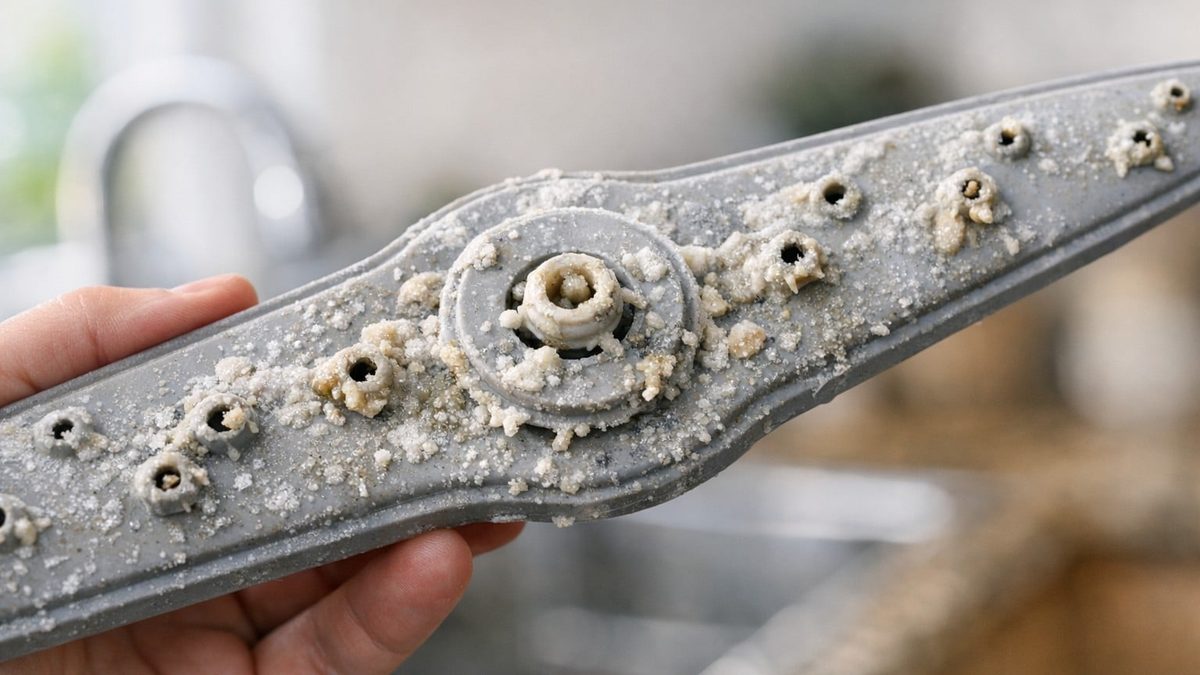
The repairman pulled out the lower basket. He gripped the spray arm and flipped it over in one sharp motion. One side looked fine. White. Smooth. Clean. The other side? A gray crust of limescale and compacted food residue. Every tiny hole was half-clogged. Some were completely blocked.
The verdict was brutal. The machine had been running for months, recirculating water at reduced pressure. It was projecting a weak, lukewarm stream onto dishes it claimed to have cleaned.
Sound familiar?
The Hidden Rot Under the Spray Arm
Every dishwasher has two spray arms. They sit on a support that lets them spin freely to degrease everything inside the tub. The logic is elegant. Water pressure pushes against angled jets, creating rotation like a garden sprinkler. But here is the catch. If the holes are blocked, that rotation doesn’t happen with enough force.
The machine spins. The cycle says “done.” Your plates come out with streaks. You blame hard water. You blame cheap detergent tabs. You don’t blame the part you never look at.
The spray arms are sensitive to grime and limescale. This buildup obstructs the tiny holes. It stops water from distributing properly. The problem is that the top face—the side facing up—stays relatively clean. Hot water rinses it every cycle. Dirt accumulates underneath. Inside the internal cavities. Out of sight. Out of mind.
Clogged nozzles or stuck arms mean water never reaches all your dishes. A dirty filter makes it worse. The filter catches food debris. If it’s clogged, water pressure drops. The arms spin slower. Cleaning fails. One problem feeds the other. Discreetly. Cycle after cycle.
The Flip That Nobody Does
Taking out the lower arm takes less than thirty seconds. You just unlock it. Turn it left or right depending on the manufacturer. Depress the clip. Pull it up. Some models just need a gentle tug upward.
Then you flip it.
What you find inside depends on your local water hardness and how you load the machine. Spray arms are the first thing to check when dishes are still dirty. The small holes project water. They get clogged over time. Limescale forms a crust inside the orifices. It narrows the jet diameter. Food fragments. Solidified grease. Tiny debris. All of it blocks the flow.
The protocol is simple. Use a toothpick to unclog the nozzles on both sides. Rinse the arms under hot running water. Make sure foreign bodies are gone. You can use a needle or a small screwdriver for stubborn spots. Remove limescale deposits with a descaler or hot water mixed with citric acid.
Twenty minutes. No special tools. No replacement parts needed.
The Frequency Nobody Respects
Clean the spray arms two to three times a year. Reality in most homes? Never. Or once when the machine breaks and forces you to open it up.
Regular maintenance reduces detergent and electricity consumption. It ensures better washing results. Fewer wasted tabs. Fewer re-run cycles because glasses come out cloudy.
To prevent holes from clogging, don’t just monitor water hardness. Scrape or rinse food scraps before loading dishes. This preventive step, combined with a monthly empty cycle at maximum temperature with a bowl of white vinegar in the tub, dissolves invisible fats. It pushes back against potential breakdowns.
Be careful. Overusing white vinegar can damage seals. Natural solutions don’t replace specific cleaners for complete maintenance. A dedicated descaler, run as an empty cycle once a month, is the reference for very hard water. This is especially true in regions like the Paris Basin or the Mediterranean coast where water hardness often exceeds 30°f.
Start with the arm. Flip it. Pick out the gunk. Watch your dishes actually get clean again. It’s a small act. One that most people skip until the water stops spraying altogether.
The Upper Spray Arm: The Overlooked Culprit
The lower arm grabs the headlines for trapping heavy food debris. But the upper spray arm isn’t sitting idle. It’s fixed to the upper rack. If you yank the rack out while it’s attached, you risk snapping the mechanism. The smart move is to remove the entire upper basket first. Then, detach the arm.
You don’t always need to take it off to clean it. A rigid piece of wire or even a paperclip can do the job. Poke through the holes from the outside. Clear the clogs. Simple.
When Cleaning Arms Isn’t Enough
If your dishes still look like they’ve been through a war zone, the issue runs deeper. Residue on the plates or sitting in the tub points to a system failure. It could be the filters. It might be the drain pump. Or the spray arms themselves are just broken.
But here’s the reality check. Most of the time, your lavage is failing because of a simple blockage. You’ve spent months troubleshooting. You’ve bought expensive cleaners. You’ve checked the settings. And yet, the solution was staring you in the face.
“In the vast majority of degraded washing cases, flipping the bottom spray arm and spending ten minutes with a toothpick fixes the problem.”
That’s it. That’s the fix. We ignore the obvious spots because we assume the problem must be complex. It rarely is.
The Pump: The Heart of the Machine
Sometimes, cleaning the arms does nothing. Then you’re dealing with the circulation pump. This is the component that forces water under pressure into the spray arms. If the water isn’t moving, the arms are just wet sticks.
How do you know if the pump is to blame? Listen.
- Abnormal humming: A buzzing sound after the fill cycle suggests the impeller is blocked or jammed.
- Total silence: If the machine fills with water and then just… stops. No spray. No rotation. The pump has likely seized or failed completely.
The Quick Fix You’ve Been Ignoring
Before you call a technician. Before you panic about replacement parts. Do the manual check.
- Pull out the bottom rack.
- Flip the lower spray arm over.
- Inspect the jets.
- Use a toothpick or a thin brush to clear any gunk.
- Check the upper arm similarly.
Ten minutes. That’s all it takes to resolve the issue you’ve been living with for months. You just weren’t looking in the right place.
Sources : comment-economiser.fr | echho.org