
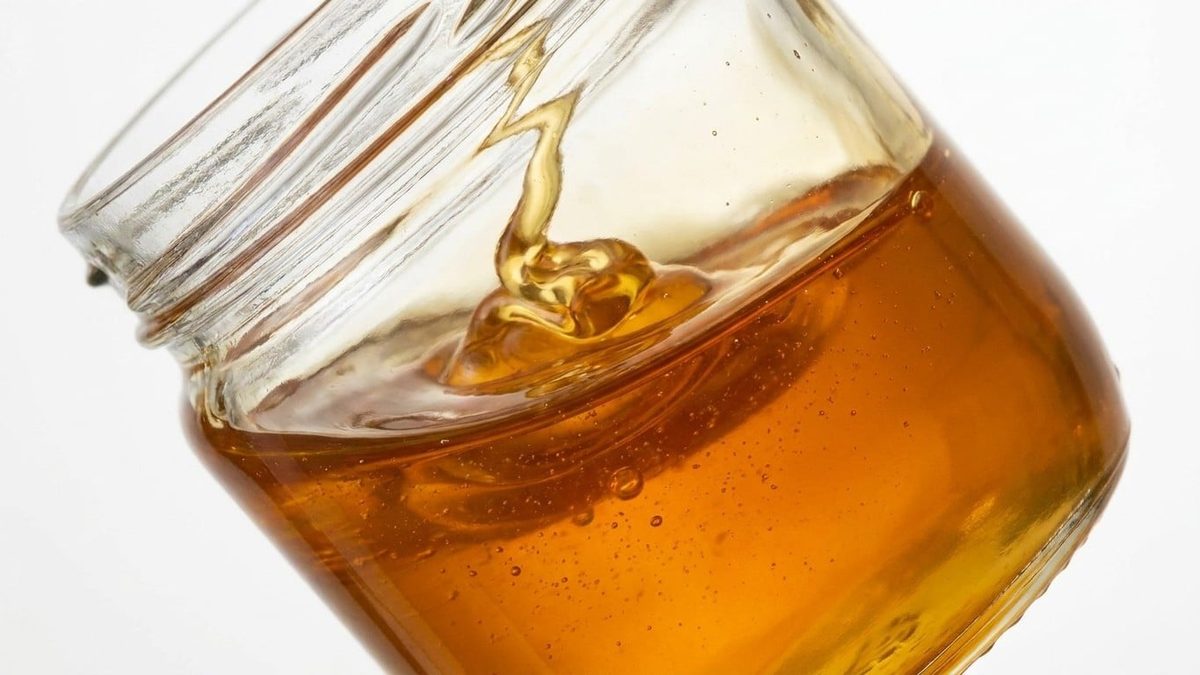
Turn your honey jar upside down. Not metaphorically. Physically. If the contents slide out against the lid in a few seconds, something is wrong. Real honey, dense and rich in natural sugars, takes time to move. This banal gesture, an apiarist in the Drôme explained to me why he does it systematically in front of his customers: to show the difference between what he produces and what you find on seven out of ten supermarket shelves.
There is a simple test to verify the authenticity of your honey. The authorities are not using it yet. But Chinese and Turkish honeys show the highest rates of adulteration, exceeding 90% in some cases. The price reveals everything: below €10/kg, fraud is highly probable.
One out of two products isn’t what it claims to be
Out of the 320 honey batches tested by the official laboratory of the Joint Research Centre (JRC) for the European Commission, 46% would not really be honey. They contain sugar syrups based on rice, wheat, or sugar beet. These results, published in March 2023 as part of the “From the Hives” operation, constitute the first official large-scale recognition of a fraud that beekeepers have been denouncing for decades.
The mechanism is terrifyingly simple. On average, honey imported into Europe costs €2.17 per kilo. Sugar syrups made from rice cost between €0.40 and €0.60 per kilo. The margin for fraudsters? Colossal. The fraudsters target the ratio of 70% syrup to 30% honey. Honey sold at full price, reduced to one-third of its real substance.
Of the 89 batches originating from China, 74% are suspected of non-compliance. For Turkey, the suspicion rate is the highest, with 14 out of 15 batches, or 93%. These figures give a new dimension to the phrase “blend of honeys not originating from the EU” that is discreetly printed on so many labels. And in France? During its last investigation, in 2024, the fraud repression agency (DGCCRF) found that more than 40% of controlled honeys were non-compliant. Since its sampling was targeted at suspect batches, this rate is likely higher than the reality of the market. But it illustrates the scale of the phenomenon.
Why fraud is so hard to detect
Fraud techniques for adulterating honeys have improved and developed to evade detection. They combine syrups of diverse plant origins and play on quantities to mimic the sugar profile of honey. This is where the real problem lies: fraudsters adapt. Honey is now adulterated with syrups from rice, wheat, and sugar beet. This differs from conventional syrups derived from corn or cane sugar. Result: old tests no longer detect anything. Conventional methods let pass what the new JRC analyses are only beginning to identify.
The situation is absurd. Current methods are not solicited for regulatory decision-making. Thus, there is no official legal definition to qualify fraud in honey. Any method used to detect honey adulteration that is not fully validated produces results that are not legally accepted. These results cannot be enough to block honey imports. A fake honey detected can therefore legally continue to circulate.
Fraud also extends to geographic origin. A common practice is to sow confusion about the countries where the honey was harvested. Packers may hesitate to indicate certain origins, which are not attractive to French eyes: China is not really appealing, and Ukraine barely more. Yet, the indication of the harvesting country is mandatory since 2022, at least if it is put in a pot in France. A requirement on paper, circumvented in practice.
French production on the line
The context makes everything worse. Barely 12,000 tonnes of honey were harvested in France in 2024. This is nearly 40% less than the previous year, due to climatic conditions, rains, and late frosts. Forty percent less: that is the equivalent of the entire harvest of an entire region disappearing from one year to the next. “France produces barely a third of its consumption in bad years. Packers import nearly 30,000 tonnes of low-priced honeys from all corners of the world every year, especially from Asia,” recalls the president of the National Union of French Beekeeping.
This structural imbalance between local production and massive imports creates exactly the conditions that fraudsters await. Less French honey available. Pressure on prices. Abundant and poorly controlled foreign offer. Chinese honeys in particular are the most suspected of adulteration. The honey aisle in the supermarket therefore reflects a sector under tension, where the consumer pays for a premium product to receive, too often, colored syrup.
Why Your Honey Might Be Fake (And How to Spot It)
Forget the water glass tests. Or the matchstick tricks. They don’t work.
The internet is flooded with DIY honey authenticity hacks, but they are largely useless. Honey is one of the most counterfeited foods on the planet. Detecting these frauds is nearly impossible for the average consumer. Visual cues or texture checks? Useless. You can’t identify a honey cut with 30% rice syrup just by looking at it. It looks the same. It tastes sweet.
However, there is one simple, free action you can take right now.
Put your jar on the shelf. Watch it.
If your honey remains liquid after six months, it’s suspect. It’s likely adulterated.
Crystallization Is a Good Thing
Let’s clear up a common misconception: crystallization is not a defect. It is a sign of quality and authenticity.
It is a natural process. It proves your honey hasn’t been ultra-filtered. It proves it hasn’t been overheated to death in a factory. When honey crystallizes, it’s saying, “I am real.”
If you buy honey and it never hardens, keep an eye on the price tag. And the label.
The Price Tell
Look at the cost. If the price is below €10 per kg, be wary. It is highly suspect of being cut or low-quality industrial sludge.
Real honey costs money. It requires weeks of labor. Ruches need tending. Flora is capricious. A genuine French honey, produced by an apiarist whose name is printed on the jar, typically sits above €15 per kg.
That price isn’t a luxury. It’s the real cost of doing business.
Read the Fine Print
The legal label reveals more than you think.
Look for the phrase: “mélange de miels non originaires de l’UE.” This indicates a blend of honeys from multiple countries. Frequently, this means a mix dominated by Chinese honey, with just enough European honey added to satisfy labeling laws.
You aren’t buying local. You are buying a global cocktail.
The Reality Check
On 320 lots analyzed at European borders, 147 were fraudulent.
The methodology developed by the Joint Research Centre (JRC) is not yet used by official control authorities. Nor is it used in routine testing by common brands.
Why? Because fraudulent dilution with sugar syrups is profitable. The risk of getting caught is low.
This isn’t a dead end. The European Honey Platform is working on a reference laboratory. It would have validated analysis methods with legal authority.
Until then?
The best defense is still the Sunday producers’ market. Buy from the person who keeps the bees. Ask them questions. Watch them bottle it.
It’s harder. It’s slower. But at least you know what’s in the jar.
“Crystallization is not a defect. It is a sign of quality and authenticity.”