You are wandering through a boutique or a farmer’s market. You see those brown cubes. They look raw. Artisanal. The label screams “Syrian treasure.” It promises calm, purified skin. But here is the thing. Your gut tells you something is off.
The shelves are stuffed with pale, industrial copies. Counterfeits are everywhere. You hesitate before handing over your money. Should you buy the real deal or just another mass-produced bar?
The Trap of Perfection
We are conditioned to look for symmetry. In the cosmetics world, a flawless design signals quality. It doesn’t. A soap shaped by human hands for centuries is never regular.
Look at the edges. If they are perfect. If the cuts are millimeter-precise. If the surface is polished to a shine. That is a factory stamp. It is not traditional craftsmanship.
An authentic block has bumps. It has hollows. The edges are irregular. Those flaws tell a story. They tell you a person made this with care.
The Oriental Seal Myth
For a long time, the Arabic calligraphy on top was a sign of trust. A beautiful seal. It added character. Now? It means nothing.
Unscrupulous manufacturers copy that stamp. A die with Eastern accents costs pennies. Seeing Arabic letters in the center proves nothing about the oils inside. Do not let the packaging fool you. You need better proof. Especially as spring cleaning approaches and your skin needs a reset.
The Truth Inside
Packaging lies. Stamps lie. The interior structure cannot cheat.
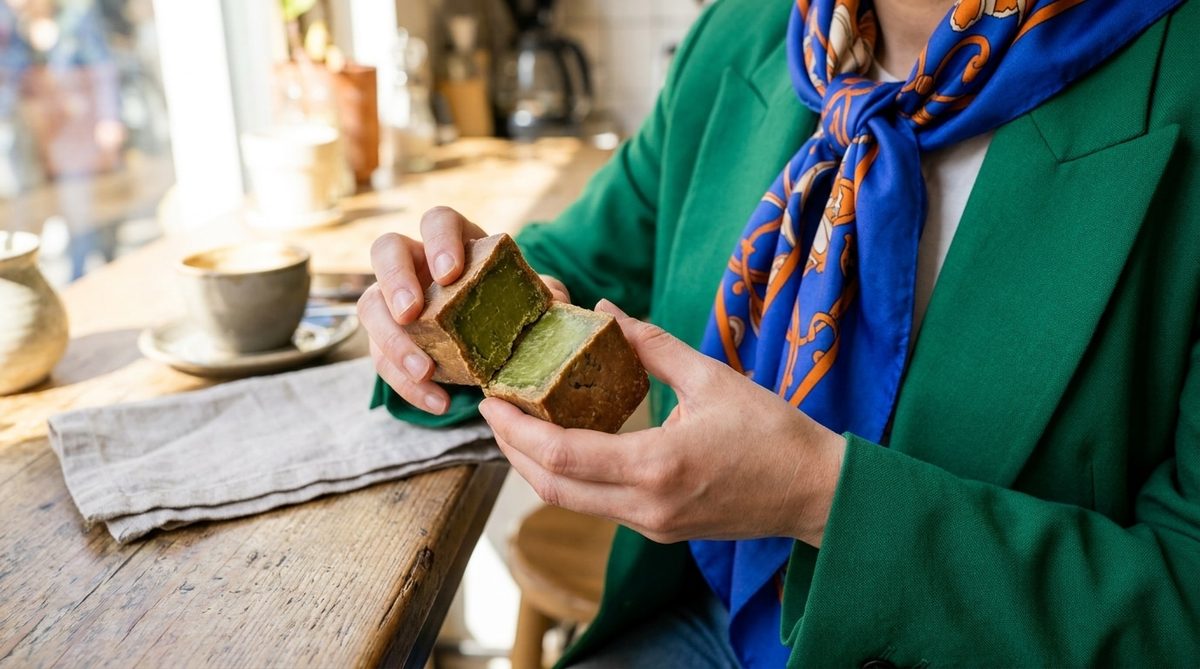
Here is the absolute weapon against doubt. Cut the product in half. A kitchen knife works fine. It is a simple gesture. It is terrifyingly effective. The masquerade ends here. The true treasure reveals its identity.
The Visual Shock
When the blade slices through the paste. A stark contrast jumps out. The rough, earthy surface gives way to a radically different core.
If the cross-section shows a uniform brown color from center to edge. Be alarmed. This is likely a rushed batch or a poor mixture dyed throughout. You are looking for bipolar contrast. This visual signature is the most reliable marker on the market.
The Emerald Signature
That green hue is not added dye. It comes from the bay laurel berry.
An authentic Aleppo soap features a green core thanks to bay laurel oil. The more of this key ingredient you have. The deeper and denser the green reflection becomes. This natural chlorophyll is what soothes skin stressed by temperature changes.
Brown Skin, Green Heart
The magic happens over nine long months. The stacks sit in ventilated cellars. The air slowly oxidizes the exterior. It freezes the outside in ochre, caramel, or Sienna tones.
The center, however, is preserved. It is shielded from air and light. It keeps the fresh, vibrant color of the raw materials. This golden crust acts as a thermal shield. It proves the soap aged slowly in natural conditions.
The Nose Knows
Stop buying based on scent alone. Forget the powdery, laboratory smells of modern perfumes.
Earthy and Raw
When you rub the soap between your hands. The scent should evoke a forest floor. An ancient oil mill. Sun-baked earth. It is a frank aroma. Almost harsh to untrained nostrils. It betrays a richness in unrefined fats.
This rustic bouquet guarantees the absence of synthetic solvents. It smells like real ingredients.
The Chemical Red Flag
If you smell lavender. Orange blossom. Or a fruity synthetic. Walk away.
Centuries-old recipes include neither essential oils nor coumarine. No added fragrances. An artisan who took the trouble to incorporate 30% precious plant extracts will not ruin the work with artificial perfume. Doing so would destroy the dermatological expertise of the product.
Your nose is a detector. Trust it.
Why True Soap Floats (And Plastic Bars Sink)
Water evaporation isn’t just a side effect of aging. It is the main event.
During the months-long cure in a cool, ventilated cave, more than a third of the bar’s initial weight vanishes. The structure tightens. The texture compacts. This density is what stops a genuine bar from turning into a sad, dissolving mush on the edge of your sink. Mass-produced imitations don’t have the luxury of time. They don’t wait. They rush. And they remain heavy with excess moisture.
This leads directly to the most reliable, almost playful test you can perform.
Drop the soap in the tub.
A properly cured block of artisanal soap, stripped of its water weight, will float. It sits high on the surface. It refuses to sink. Conversely, the vast majority of industrial dupes will plummet. They drag themselves to the bottom of the basin. Why? Because they are still gorged on fluids. They are denser than water. They are cheating the process.
If your bar sinks, it likely didn’t undergo the long, slow drying required for real saponification to mature. You are left with a product that looks like soap but behaves like a chemical sponge.
Decoding the INCI List
Turn the bar over. Look at the back.
Ignore the marketing fluff. Ignore the pretty words printed on the front. The truth is in the INCI list—the International Nomenclature of Cosmetic Ingredients. A true, traditional soap bar should have a list so short you could count it on one hand.
You should see only a few items:
- Sodium Olivate (from olive oil)
- Sodium Laureate (from bay laurel)
- Water
- Sodium Hydroxide (the lye, which disappears during saponification)
That’s it.
If you see preservatives? That’s a red flag. If you see EDTA? That’s a chelating agent used to stabilize synthetic formulas. If you see harsh chemical surfactants? You aren’t looking at a natural soap. You’re looking at a detergent wrapped in a pretty label. These are the gross plagiarisms found on supermarket shelves. They mask their lack of true saponification with additives.
Choosing the Right Laurel Percentage
Not all laurel soaps are created equal. The percentage of bay laurel oil matters. It dictates how the soap interacts with your skin.
If your skin is generally healthy—no major issues, just needs a good clean—aim for a bar with around 12% laurel oil. This is perfect for daily hygiene. It cleans without stripping.
But if you are dealing with stubborn skin troubles? Maybe you’re under stress. Maybe your skin feels inflamed or irritated. In those cases, you need more power. Look for a formulation that jumps to 30% or even 40% laurel. The higher concentration amplifies the purifying, soothing properties of the oil. It helps tackle the recalcitrant discomforts that a mild wash can’t touch.
But you can’t know what’s inside unless you’ve already passed the first two tests. You need a bar that floats. You need a label that bleeds nothing but oil and lye.
The Hidden Green Heart
Finally, look at the cross-section.
A traditional soap made with bay laurel has a distinctive interior. Beneath the thick, rough, brownish rind—the “croûte” formed during drying—lies a vibrant, emerald green core. This isn’t an added dye. It is the natural hue of the bay laurel oil, concentrated by the long aging process.
This green heart is proof of heritage. It proves the soap wasn’t rushed. It proves the oil survived the saponification process intact. It confirms the presence of real bay laurel, not just a drop of fragrance oil.
Once you know what to look for—floating weight, minimal ingredients, and that signature green center—you stop guessing. You stop falling for marketing traps. You stop buying soap that dissolves into sludge.
You start caring for your skin with something that actually respects it. The rest is just history, waiting to be used.